
Google Certificate Career Value Calculator
Your Profile & Goals
Analysis Results
Enter your details and click calculate to see if a Google Certificate is the right move for you in 2026.
You’ve seen the ads. You know your friends are doing them. The question isn’t whether Google certificates are popular-they absolutely are. The real question is whether they actually move the needle for your career in 2026.
I’ve spent years watching the e-learning landscape shift from novelty to necessity. As someone who has navigated hiring processes and mentored dozens of professionals trying to pivot careers, I can tell you this: the answer isn't a simple yes or no. It depends entirely on where you are right now and what you want to achieve next.
Quick Takeaways
- For beginners: Google Certificates provide structured entry points into high-demand fields like Data Analytics and UX Design without requiring a four-year degree.
- For experienced pros: They offer targeted skill refreshers but rarely replace deep, specialized industry experience or advanced degrees.
- The Employer View: Major companies recognize these credentials, but they view them as proof of foundational competence, not mastery.
- ROI Reality: The cost is low (via Coursera), but the time investment is significant; expect 3-6 months of consistent study per certificate.
- Best Use Case: Breaking into tech-adjacent roles, upskilling within a current role, or validating self-taught skills with a recognized brand name.
What Exactly Are Google Certificates?
To understand their value, we first need to define what they are. These aren’t traditional academic degrees from universities. Instead, they are vocational-style credentials designed by Google in partnership with Coursera.
They focus on practical, job-ready skills rather than theoretical computer science or business theory. For example, the Google Data Analytics Professional Certificate teaches you how to use spreadsheets, SQL, R programming, and Tableau to analyze data. It doesn’t teach you the mathematical proofs behind statistical models. That distinction matters.
As of 2026, Google offers certificates in several key areas:
- Data Analytics
- Digital Marketing & E-commerce
- IT Support
- User Experience (UX) Design
- Project Management
- Cybersecurity
- Growth & Product Marketing
Each program typically consists of 5-8 courses, taking roughly 6-10 hours per week to complete if you’re studying part-time. The total duration usually ranges from three to six months.
The Job Market Reality in 2026
Let’s talk about the elephant in the room: will this get you hired? In 2024 and 2025, there was a surge in people earning these certificates. By 2026, the market has adjusted. Employers are no longer surprised to see a Google Certificate on a resume. In fact, many hiring managers now consider it a baseline expectation for entry-level candidates in tech-adjacent roles.
This creates a double-edged sword. On one hand, having the certificate signals that you have the discipline to finish a structured program and possess verified technical skills. On the other hand, it no longer guarantees an interview because so many applicants have it.
However, don’t let that discourage you. The value hasn’t disappeared; it has just become more nuanced. According to recent labor market trends, employers in sectors like retail, healthcare administration, and mid-sized tech firms still heavily weight these credentials because they reduce training time. If you can walk into a junior analyst role already knowing how to clean data in Excel and write basic SQL queries, you save the company weeks of onboarding.
Who Should Get a Google Certificate?
Not everyone needs one. To determine if it’s worth your time and money, ask yourself which of these profiles fits you best.
The Career Switcher
If you are currently working in hospitality, sales, or education and want to move into tech, a Google Certificate is one of the most efficient bridges available. It provides a standardized curriculum that helps you build a portfolio. For instance, the Google UX Design Certificate requires you to create case studies for your final project. These case studies become the core of your portfolio, which is far more important to hiring managers than the certificate itself.
The Upskiller
Are you a marketing manager who feels outdated in digital tools? Or an IT helpdesk worker wanting to move into cybersecurity? These certificates are excellent for filling specific knowledge gaps. They are concise enough to complete alongside a full-time job, allowing you to gain new competencies without pausing your income.
The Self-Taught Validator
Maybe you’ve been watching YouTube tutorials on Python or SEO for two years. You know the stuff, but you can’t prove it. A Google Certificate acts as a third-party validation of your skills. It gives recruiters a concrete talking point during interviews: "I didn’t just watch videos; I completed a rigorous assessment."
Who Should Skip It?
Conversely, some people would be better off investing their time elsewhere.
Senior Professionals: If you have ten years of experience in data science, adding a beginner-level Data Analytics certificate to your LinkedIn profile might actually hurt your credibility. It signals that you lack deeper expertise. Senior roles require strategic thinking and leadership, which these vocational courses do not cover.
Academic Pursuers: If your goal is to work in research, academia, or highly specialized engineering, a Google Certificate holds little weight. You’ll need formal degrees or certifications from bodies like IEEE or ACM.
Those Seeking Quick Riches: If you think earning this certificate will instantly land you a $100,000 job without any additional effort, you’re mistaken. The certificate opens the door; you still have to knock hard through networking, interviewing, and building a strong portfolio.
Cost vs. Return on Investment
Let’s look at the numbers. A Google Certificate costs approximately $39 USD per month via Coursera until completion. Most people finish in 3-6 months, putting the total cost between $120 and $240. Some users may qualify for financial aid, making it free.
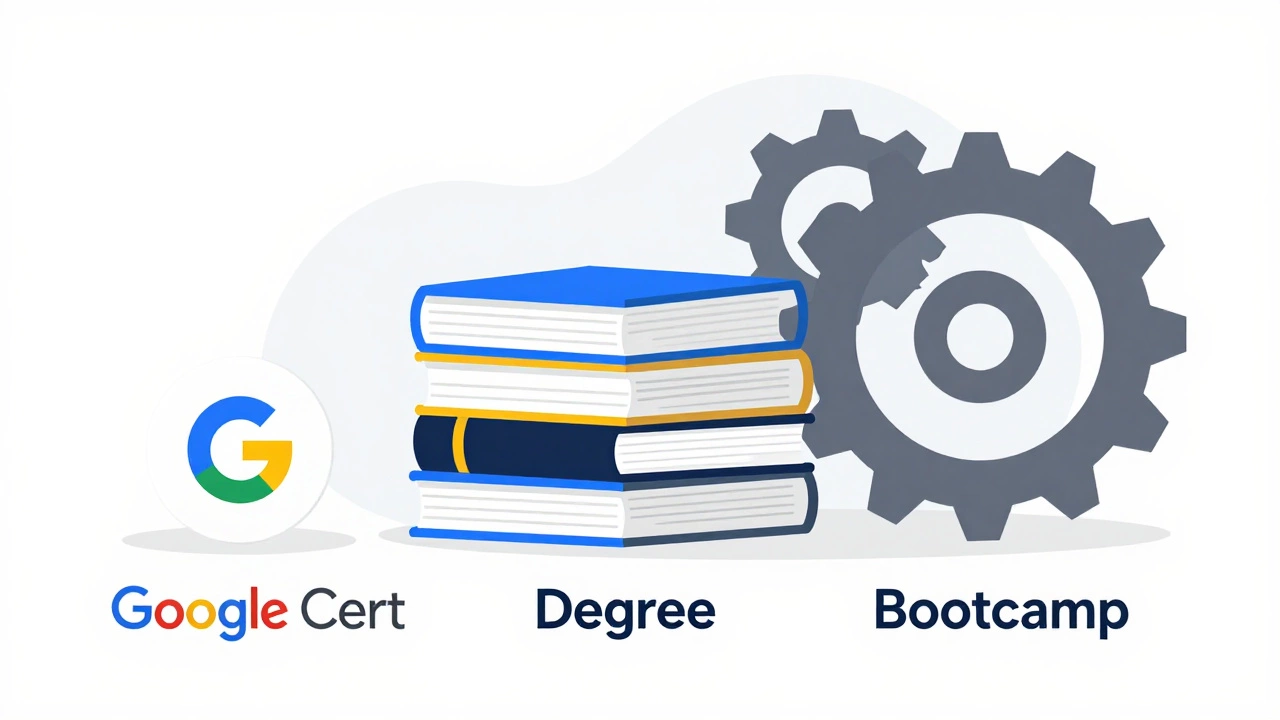
Compare this to a bootcamp, which can cost $10,000+, or a university degree costing tens of thousands. The financial risk is minimal. The bigger investment is time. Expect to dedicate 150-200 hours of focused study.
Is it worth it? If landing a single entry-level job increases your annual salary by even $10,000, the ROI is astronomical. But remember, the certificate alone rarely lands the job. It’s the combination of the certificate + portfolio + network that works.
How to Maximize the Value of Your Certificate
Earning the badge is only step one. Here is how you turn that piece of digital paper into actual career capital.
- Build a Public Portfolio: Don’t just hide your course projects in Coursera. Repackage them. If you did a data analysis project, publish the code on GitHub and write a blog post explaining your findings. If you did UX design, create a Behance profile showcasing your user research and wireframes.
- Network Aggressively: Join local meetups or online communities related to your field. Tell people, "I’m transitioning into data analytics and just finished my certification." People hire people they know. The certificate gives you a reason to start conversations.
- Apply Immediately: Start applying for jobs while you are still studying, especially for internships or apprenticeships. Many employers value the momentum of a candidate who is actively learning.
- Combine with Soft Skills: Technical skills get you the interview; soft skills get you the job. Practice communicating complex ideas simply. This is crucial for roles like Project Management and UX Design.

Comparison: Google Certificates vs. Alternatives
| Feature | Google Certificates | Coding Bootcamps | University Degree |
|---|---|---|---|
| Time Commitment | 3-6 Months (Part-time) | 3-6 Months (Full-time intensive) | 4 Years |
| Cost | $120-$240 | $10,000 - $20,000+ | $20,000 - $100,000+ |
| Depth of Knowledge | Foundational / Vocational | Practical / Project-based | Theoretical / Comprehensive |
| Best For | Career switchers, upskillers | Aspiring software engineers | Researchers, academics, specialized roles |
| Employer Perception | Good for entry-level | Variable (depends on school reputation) | High (standard requirement for many roles) |
Frequently Asked Questions
Do employers actually care about Google Certificates in 2026?
Yes, but with nuance. Large corporations and government agencies often have partnerships with Google, making these certificates recognizable and respected for entry-level positions. However, they are viewed as proof of foundational skills, not mastery. They help you pass automated resume screens and demonstrate initiative, but they rarely replace hands-on experience or a degree for senior roles.
Which Google Certificate is best for getting a job quickly?
The Google IT Support Professional Certificate and the Google Data Analytics Professional Certificate generally have the highest demand for entry-level roles. IT support roles are abundant across all industries, while data analytics skills are needed in marketing, finance, healthcare, and operations. UX Design is also popular but often requires a stronger portfolio to stand out.
Can I get a Google Certificate for free?
Yes. Coursera offers financial aid for most Google Professional Certificates. You apply through a form on the course page, explaining your financial situation and why you want to take the course. Approval usually takes about 15 days. Additionally, some libraries and community centers offer free access to Coursera Plus, which includes these certificates.
Is a Google Certificate better than a bootcamp?
It depends on your goals and budget. Google Certificates are far cheaper and more flexible, making them ideal for self-motivated learners and career switchers on a tight budget. Bootcamps offer immersive environments, career coaching, and peer networks, which can be valuable if you struggle with self-discipline or need intensive job placement support. However, bootcamps carry significantly higher financial risk.
Does the Google Certificate expire?
No, the certificate itself does not expire. Once you earn it, it stays on your record forever. However, technology changes rapidly. Skills learned in a Data Analytics course today might be slightly outdated in five years. Therefore, continuous learning is essential regardless of the credential you hold.
Can I use a Google Certificate to get a visa or work abroad?
Generally, no. Work visas typically require formal educational qualifications recognized by national accreditation bodies, such as a bachelor’s or master’s degree. While a Google Certificate demonstrates competency, it is not considered a tertiary education qualification for immigration purposes in most countries, including Australia, the US, and the UK.
Next Steps: Making Your Decision
If you’re sitting on the fence, here is a simple decision tree:
- Choose YES if: You are new to the field, need a structured learning path, have a limited budget, and are willing to put in 3-6 months of consistent part-time study to build a portfolio.
- Choose NO if: You already have significant experience in the field, are looking for advanced theoretical knowledge, or expect the certificate alone to guarantee a high-paying job without further effort.
The world of work is changing. Formal degrees are losing some of their monopoly on opportunity. Credentials like Google Certificates are democratizing access to skilled professions. They won’t do the work for you, but they can give you the tools to start. The real value lies not in the badge you pin to your LinkedIn, but in the skills you practice and the problems you learn to solve.









0 Comments