
Find Your First Programming Language
What is your primary goal?
Select the outcome that excites you most.
How do you prefer to learn?
Choose the environment that sounds most comfortable.
What is your time commitment?
Be honest about how much time you can dedicate.
We Recommend:
Best For:
Learning Curve:
Suggested First Steps:
Staring at a blank screen and wondering where to start with coding is a universal experience. You’ve heard that learning to code opens doors to high-paying jobs, creative projects, or just the ability to automate boring tasks. But the sheer number of languages-Python, JavaScript, Java, C++, SQL-is enough to make anyone freeze. The question isn’t really “which language is the best?” because every language has its strengths. The real question is: which one will keep you motivated long enough to actually learn?
For most beginners in 2026, the answer depends entirely on what you want to build. If you want to see visual results immediately, you need a different tool than if you want to analyze data or build mobile apps. Let’s cut through the noise and look at the practical options available today.
Why Python Is the Default Starting Point
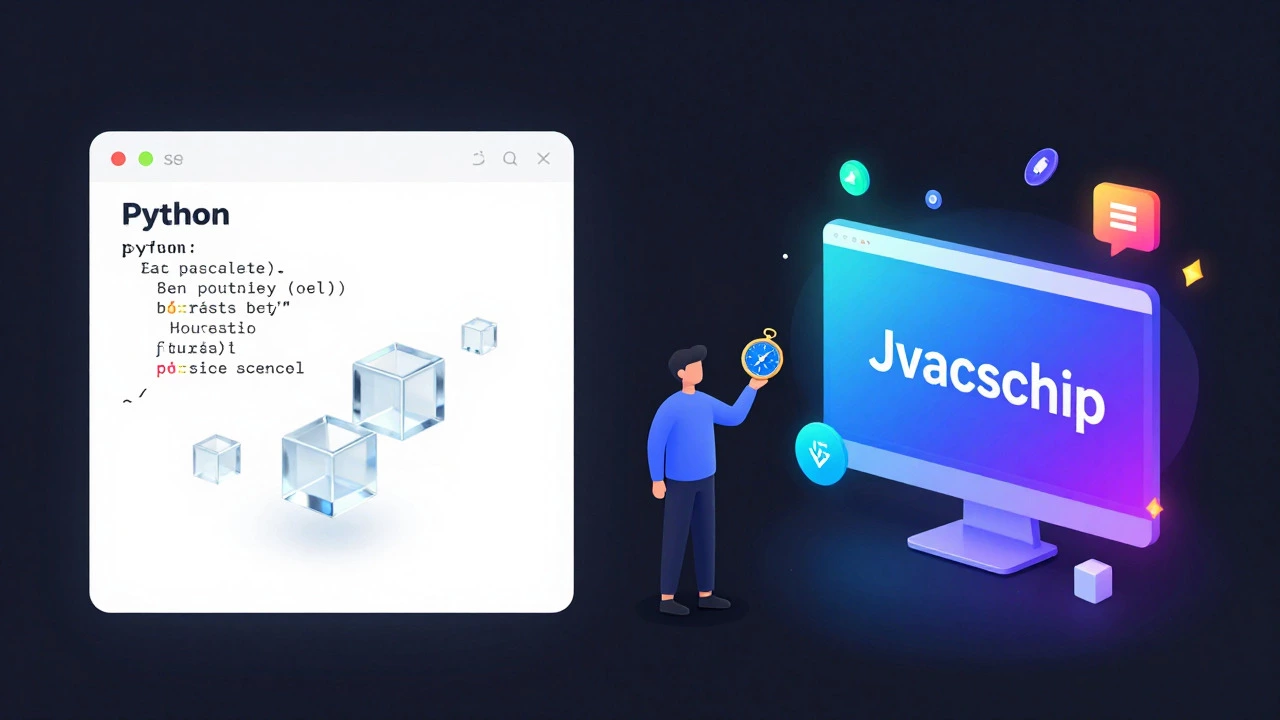
If you ask ten coding instructors which language they recommend first, seven will say Python is a high-level programming language known for its readability and simplicity. It’s not an accident. Python reads almost like plain English. Instead of cluttering your code with semicolons and curly braces, you use indentation to structure your logic. This reduces the cognitive load when you’re trying to understand both syntax and logic simultaneously.
Python dominates in several key areas that appeal to beginners:
- Data Science and AI: With libraries like Pandas and TensorFlow, Python is the industry standard for analyzing data and building machine learning models.
- Automation: You can write a script in five minutes to rename thousands of files or scrape information from websites.
- Web Backend: Frameworks like Django and Flask allow you to build server-side applications quickly.
The downside? Python isn’t great for mobile app development or high-performance game engines. But as a first language, it teaches you core concepts-variables, loops, functions, and objects-without fighting the syntax. Once you understand these concepts in Python, picking up another language becomes much easier.
JavaScript for Visual Learners
If you get bored easily and need to see something happen on the screen to stay engaged, JavaScript is the programming language of the web that runs in browsers. Unlike Python, which often requires setting up a local environment and running commands in a terminal, JavaScript lives in your browser. You can open Chrome, press F12 to open the developer console, type `alert("Hello World")`, and see immediate feedback.
This instant gratification is powerful. When you combine JavaScript with HTML (structure) and CSS (style), you have the full stack of web development. You can build interactive websites, animations, and even simple games without installing heavy software. In 2026, frameworks like React and Vue.js are still the dominant forces for building user interfaces, but they all rest on vanilla JavaScript fundamentals.
The catch is that JavaScript has some quirky behaviors. For example, `[] + []` equals an empty string, while `[] + {}` equals `[object Object]`. These oddities can be confusing for beginners, but they also teach you how computers handle data types differently. If your goal is to become a frontend developer or build websites, JavaScript is non-negotiable.
HTML and CSS: Not Code, But Essential
Here’s a common misconception: HTML and CSS are not programming languages. They don’t have logic, loops, or variables in the traditional sense. HTML (HyperText Markup Language is the standard markup language for documents designed to be displayed in a web browser.) defines the structure of a webpage, while CSS (Cascading Style Sheets is a style sheet language used for describing the presentation of a document written in HTML.) controls how it looks.
However, starting with HTML and CSS is often the best way to ease into the world of coding. Why? Because there’s no "right" or "wrong" output. If you change a color code from `#ff0000` to `#00ff00`, the text turns green. It’s predictable and forgiving. Many beginners burn out because their first Python script crashes with a cryptic error message. HTML/CSS errors usually just mean something looks slightly off, which is easier to debug visually.
Think of HTML/CSS as the foundation. You can’t build a house without a foundation, but the foundation alone isn’t a house. Once you’re comfortable styling pages, adding JavaScript brings them to life.
When to Consider Other Languages
While Python and JavaScript cover 80% of beginner needs, there are specific paths where other languages make more sense.
| Language | Best For | Learning Curve | Job Market Demand |
|---|---|---|---|
| Python | Data Science, AI, Automation, Backend Web | Low | Very High |
| JavaScript | Frontend Web Development, Full-Stack | Medium | Very High |
| SQL | Database Management, Data Analysis | Low | High |
| Java | Enterprise Software, Android Apps | High | High |
| C++ | Game Development, System Programming | Very High | Moderate |
SQL is worth mentioning separately. If you’re interested in business intelligence, marketing analytics, or any role that involves working with data, SQL is essential. It’s declarative, meaning you tell the database *what* you want, not *how* to get it. It’s relatively easy to pick up the basics, and unlike general-purpose languages, it has a very narrow focus, making it less overwhelming.
Java and C++ are often taught in computer science degrees because they enforce strict rules about memory management and object-oriented design. While this builds strong foundational knowledge, the steep learning curve can discourage hobbyists. Unless you specifically want to build Android apps (Java/Kotlin) or high-performance games (C++/C#), these aren’t ideal first steps for casual learners.
How to Choose Your Path
Your choice should align with your end goal. Here’s a quick decision tree:
- Do you want to build websites? Start with HTML/CSS, then move to JavaScript.
- Are you interested in data, AI, or automation? Start with Python.
- Do you want to work in corporate enterprise software? Consider Java or C#.
- Are you aiming for game development? Learn C# with Unity or C++ with Unreal Engine.
Don’t worry about picking the "wrong" language. The concepts transfer. If you learn loops in Python, you’ll understand loops in JavaScript. The syntax changes, but the logic remains the same. The biggest mistake beginners make is spending months researching instead of writing code. Pick one, stick with it for three months, and build small projects.
Common Pitfalls to Avoid
Even with the right language, many beginners quit within the first few weeks. Here’s why:
- Tutorial Hell: Watching endless videos without typing code yourself. You must break things to learn how to fix them.
- Perfectionism: Expecting your first program to be flawless. It won’t be. Embrace bugs as learning opportunities.
- Skipping Fundamentals: Jumping straight into complex frameworks like React or Django before understanding basic variables and functions. Build a solid base first.
In 2026, resources are better than ever. Free platforms like freeCodeCamp, Codecademy, and official documentation provide structured paths. Join communities like Stack Overflow or Reddit’s r/learnprogramming to get help when you’re stuck. The key is consistency-not intensity. Coding for 30 minutes daily is far more effective than cramming for 10 hours once a month.
Is Python harder than JavaScript?
Generally, Python is considered easier for absolute beginners because its syntax is cleaner and more readable. JavaScript has more quirks and requires understanding how browsers execute code, which adds complexity early on. However, JavaScript offers immediate visual feedback, which can be motivating for some learners.
Can I learn to code without a computer science degree?
Absolutely. Most successful developers are self-taught or learned through bootcamps. Employers care more about your portfolio and problem-solving skills than your academic background. Focus on building real projects rather than collecting certificates.
How long does it take to learn coding?
It depends on your goals. You can learn the basics of a language like Python in a few weeks. To become job-ready as a junior developer typically takes 6-12 months of consistent practice. Mastery is a lifelong journey, but you don’t need to be an expert to start building useful things.
Should I learn HTML and CSS before JavaScript?
Yes, if you’re interested in web development. HTML and CSS provide the structure and style that JavaScript manipulates. Understanding them makes learning JavaScript much easier because you’ll know exactly what elements you’re interacting with on the page.
Is it too late to start coding in my 30s or 40s?
No. Age is rarely a barrier in tech. Many people switch careers later in life. Your professional experience in other fields can actually be an advantage, especially in roles that require domain knowledge combined with technical skills.





0 Comments