
Coding Career Math Calculator
🌐Web Development
Building websites, layouts, and user interfaces.
📱Mobile App Dev
Creating apps for iOS and Android devices.
🎮Game Development
3D rendering, physics simulations, and engines.
📊Data Science / AI
Machine learning models and statistical analysis.
🔒Cybersecurity
Network protocols and encryption standards.
⚙️Backend Engineering
Server logic, databases, and system architecture.
Select a Field
Waiting...Math Concepts Needed:
- Choose a card above to view details.
Typical Daily Tasks:
Tasks will appear here once you select a career path.
Picture this: you’re sitting in a classroom, staring at a quadratic equation that looks like alien hieroglyphics. Your heart sinks. You’ve always struggled with numbers, and now you’re told that coding is basically just math with different symbols. Is it true? Do you need to be a calculus wizard to write a simple website or build an app?
The short answer is no. The long answer is a bit more nuanced, but it’s overwhelmingly positive for anyone who has ever felt intimidated by algebra. While computer science the study of computation, automation, and information has deep roots in mathematics, the day-to-day reality of writing software is quite different. Most professional developers do not solve integrals or derive proofs while they work. Instead, they use logic, pattern recognition, and problem-solving skills that are accessible to almost everyone.
What Kind of Math Actually Matters in Programming?
To understand why you don’t need advanced math, we first need to look at what kind of math is used in coding. It’s rarely the complex stuff you see in university textbooks. For the vast majority of jobs, the math required is basic arithmetic and simple algebra.
- Arithmetic: Adding, subtracting, multiplying, and dividing. If you can calculate a tip or split a bill, you have the foundational skills needed for most variable operations.
- Basic Algebra: Understanding variables (like x and y) and how changing one value affects another. In code, if `x = 5` and `y = x + 2`, then `y` is 7. That’s it.
- Boolean Logic: This is the closest thing to "math" in daily coding. It involves True/False statements. For example, "If the user is logged in AND has admin rights, show the dashboard." It’s logical reasoning, not calculation.
You might hear about binary numbers a base-2 number system using only 0 and 1, which is how computers store data. While understanding binary helps you grasp how computers work under the hood, you will almost never manually convert decimal to binary in your job. Modern languages handle this for you.
Web Development vs. Data Science: A Tale of Two Careers
The question "do I need math to code" often gets a yes or no because people confuse different types of programming. The industry is broad, and the math requirements vary wildly depending on what you build.
| Field | Math Level Required | Typical Tasks |
|---|---|---|
| Web Development | Minimal (Arithmetic) | Building layouts, handling user input, connecting databases |
| Mobile App Dev | Low (Logic & Geometry) | UI design, touch interactions, basic animations |
| Game Development | Moderate to High (Linear Algebra, Physics) | 3D rendering, collision detection, physics simulations |
| Data Science / AI | High (Statistics, Calculus, Linear Algebra) | Machine learning models, statistical analysis, neural networks |
| Cybersecurity | Low to Moderate (Cryptography basics) | Network protocols, encryption standards, logic puzzles |
If you want to become a web developer a programmer who builds websites and web applications, you will spend most of your time working with HTML, CSS, and JavaScript. You’ll be figuring out how to make a button turn blue when clicked or ensuring a form validates an email address correctly. None of this requires calculus. Even backend development, where you manage server data, mostly involves organizing information logically rather than performing heavy calculations.
However, if your dream is to work in artificial intelligence technology that simulates human intelligence processes or machine learning, the story changes. These fields rely heavily on statistics and linear algebra. Algorithms need to process massive datasets, find patterns, and predict outcomes. Here, math isn’t just helpful; it’s essential. But even in these high-math roles, many tools abstract the complex equations away, allowing engineers to focus on application rather than derivation.
Logic Over Calculation: The Real Skill Set
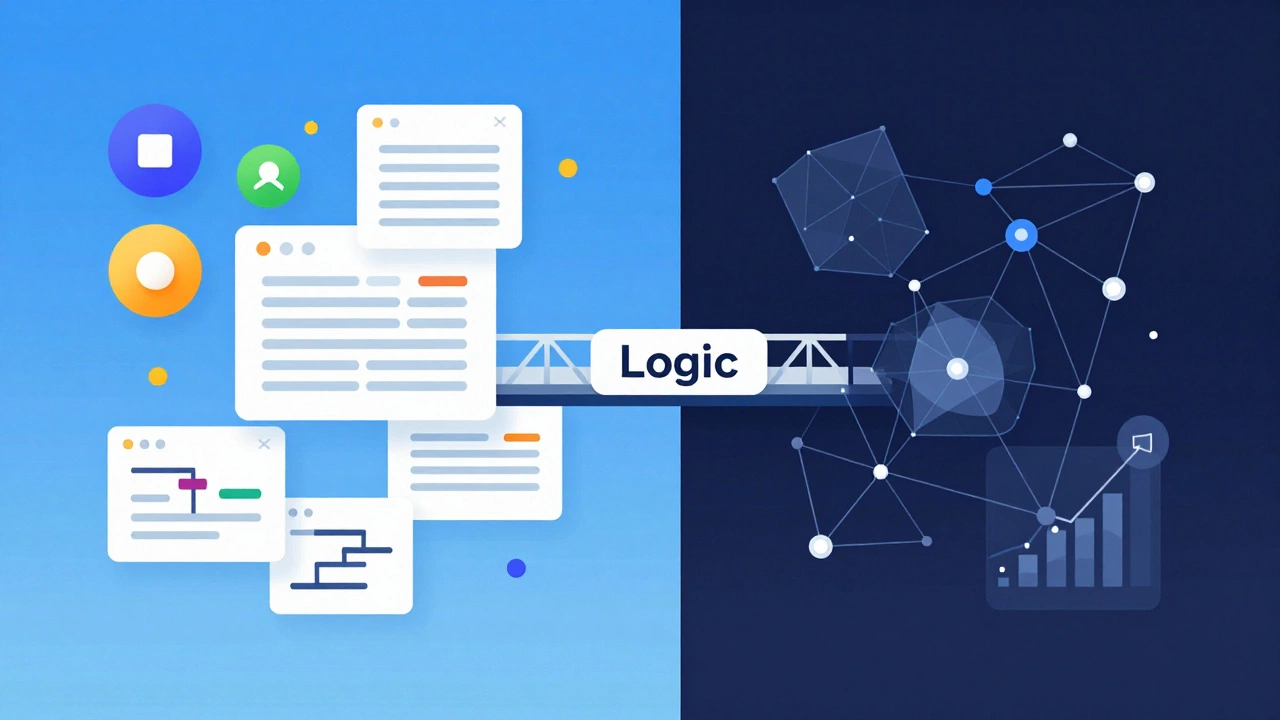
So, if math isn’t the barrier, what is? The core skill of coding is computational thinking a problem-solving process that includes formulating problems and solutions so that they can be represented as computational steps. This is less about numbers and more about structure.
Think of coding like giving directions to a friend who follows instructions literally. You don’t need to know the geometry of the street grid; you just need to break down the journey into clear, sequential steps: "Turn left," "Walk two blocks," "Stop at the red light." If you miss a step, your friend crashes into a lamppost. In coding, this is called debugging.
This logical breakdown is something humans naturally develop. We do it when we plan a trip, organize a closet, or follow a recipe. Coding simply formalizes this process. You teach the computer how to think, not what to calculate. The computer is incredibly good at calculation; it’s terrible at common sense. Your job is to provide that common sense through logic.
Common Myths That Scare Beginners Away
There are several persistent myths in the tech community that discourage people from starting to code. Let’s bust them once and for all.
Myth 1: You need to be a genius. Many people believe that programmers are born with a special brain for numbers. In reality, most successful developers are just curious people who enjoy solving puzzles. They hit walls constantly, search for answers online, and learn from mistakes. It’s a craft, not a gift.
Myth 2: You must memorize everything. You don’t need to memorize syntax or formulas. Professional developers Google things all day long. Knowing how to find documentation and understand error messages is far more valuable than having a photographic memory for math equations.
Myth 3: Math class predicts coding success. Doing well in high school math doesn’t guarantee you’ll be a good coder, and failing math doesn’t mean you’ll fail at coding. Coding requires creativity and persistence. Many great developers were average or poor students in traditional math classes because they didn’t engage with the material, not because they lacked ability.
How to Start Coding Without Math Anxiety
If you’re ready to take the leap but still feel nervous about the numbers, here is a practical path forward that minimizes math exposure while maximizing skill building.
- Start with Visual Programming: Tools like Scratch or Blockly allow you to code by dragging and dropping blocks. This teaches logic and flow without any typing or numbers. It’s used in schools worldwide to introduce kids to concepts before they hit algebra.
- Pick a Beginner-Friendly Language: Python is often recommended because its syntax reads like English. JavaScript is great if you want to see immediate visual results on a webpage. Both require minimal math to get started.
- Focus on Projects, Not Theory: Don’t start with a textbook on algorithms. Build a personal portfolio website, a to-do list app, or a simple game. Learning by doing reinforces concepts better than abstract study.
- Use Online Resources: Platforms like freeCodeCamp, Codecademy, or Udemy offer structured paths that guide you step-by-step. They explain concepts in plain language, avoiding unnecessary mathematical jargon.
- Join a Community: Connect with other beginners on forums like Stack Overflow or Reddit. You’ll quickly realize that everyone struggles with the same basic issues, and none of them are worrying about their calculus grades.

When Does Math Become Important?
While you can start without it, there are moments in your career where brushing up on math might help. This usually happens when you move into specialized areas or optimize performance-critical code.
For example, if you’re building a graphics engine, you’ll need to understand vectors and matrices to rotate objects in 3D space. If you’re optimizing a database query, understanding basic complexity theory (Big O notation) helps you choose efficient algorithms. However, these are advanced topics. You can work as a developer for years without touching them. When you do encounter them, you can learn the specific math concepts you need at that moment, rather than trying to master them upfront.
Also, consider that many modern frameworks and libraries handle the heavy lifting. If you’re building a charting library, you don’t need to derive the trigonometric functions yourself; you use a pre-built tool that does it for you. Your role shifts from mathematician to architect, deciding which tools to use and how to integrate them.
Final Thoughts: Your Brain is Ready
The idea that coding is exclusively for math whizzes is outdated. The tech industry needs diverse thinkers, creatives, writers, and organizers-not just number crunchers. If you can break a problem down into smaller pieces and think logically through a sequence of steps, you already have the mindset needed to code.
Don’t let a bad grade in tenth-grade algebra stop you from building the next big app or automating your workflow. Start small, stay curious, and remember that every expert was once a beginner who didn’t know anything. The code will come. The math? Well, you’ll pick up what you need along the way, one line at a time.
Can I become a software engineer without knowing calculus?
Yes, absolutely. Most software engineering roles, especially in web development, mobile apps, and enterprise software, do not require calculus. Calculus is primarily used in fields like physics simulations, advanced graphics, and machine learning. For general software engineering, strong logic and problem-solving skills are far more important than advanced mathematical knowledge.
Is Python easy to learn for someone bad at math?
Python is widely considered one of the best languages for beginners, including those who struggle with math. Its syntax is clean and readable, resembling plain English. You can build functional programs, automate tasks, and create websites using Python with only basic arithmetic knowledge. It allows you to focus on logic and structure rather than complex mathematical notation.
Do I need to understand binary to code?
No, you do not need to understand binary to write code effectively. While binary (base-2) is the fundamental language of computers, modern programming languages and compilers handle the conversion between human-readable code and binary automatically. Understanding binary can be interesting for deeper computer science knowledge, but it is not a prerequisite for becoming a proficient developer.
What is the hardest part of coding for non-math people?
The hardest part is often not math, but debugging and logical structuring. Debugging requires patience and a systematic approach to finding errors in your code. Logical structuring involves breaking down complex problems into small, manageable steps. These skills are learned through practice and experience, not through mathematical education. Many beginners find that their initial anxiety fades as they gain confidence in their problem-solving abilities.
Can I switch careers to coding if I haven't studied math in years?
Yes, many people successfully switch careers to coding without recent math study. The tech industry values practical skills and portfolio projects over academic backgrounds. Bootcamps and self-learning resources are designed for adults with various educational histories. As long as you are willing to learn new concepts and persist through challenges, your past math performance is not a barrier to entry.







0 Comments