
JEE Syllabus Topic Checker
Enter a topic to see if it's included in the JEE syllabus.
Every year, over 1.5 million students in India prepare for the IIT JEE - not just to get into an IIT, but to crack a system that’s built on precision, depth, and relentless discipline. The syllabus isn’t just a list of topics. It’s the blueprint of your entire preparation. Get it wrong, and you waste months. Get it right, and you build a foundation that carries you through both exams and beyond.
Understanding the Two Stages: JEE Main and JEE Advanced
The IIT JEE isn’t one exam. It’s two - JEE Main and JEE Advanced. JEE Main is the gateway. Clear it, and you qualify for JEE Advanced, the real filter for IIT admission. The syllabus overlaps heavily, but Advanced digs deeper into concepts, problem-solving, and application.
Both exams cover three core subjects: Physics, Chemistry, and Mathematics. No exceptions. No shortcuts. You can’t skip a chapter and hope to score. The syllabus is fixed, published every year by the National Testing Agency (NTA) for JEE Main and the IITs for JEE Advanced. And yes - it hasn’t changed significantly since 2020. You’re working with a stable, well-documented structure.
Physics Syllabus: Concepts Over Calculations
Physics in JEE isn’t about memorizing formulas. It’s about understanding how forces, fields, and energy interact. The syllabus is divided into 20 major units, each with clear weightage.
- Mechanics - This is the biggest chunk. Covers kinematics, Newton’s laws, circular motion, work-energy, rotational dynamics, and fluid mechanics. Expect at least 4-5 questions here in JEE Main.
- Electrodynamics - Electrostatics, current electricity, magnetism, electromagnetic induction, and AC circuits. This section links directly to real-world tech - think transformers, motors, and power grids.
- Modern Physics - Atomic structure, nuclear physics, semiconductors, and photoelectric effect. This is high-yield. Easy to score if you’ve practiced numericals.
- Optics and Waves - Ray optics, wave optics, interference, diffraction. Don’t ignore ray diagrams. They’re simple, scoring, and often repeated.
- Thermodynamics and Kinetic Theory - Laws of thermodynamics, heat engines, kinetic theory of gases. These topics appear in both JEE Main and Advanced, but Advanced adds tricky graphs and cyclic processes.
Advanced questions in Physics often combine two or more units. For example, a single problem might ask you to calculate the motion of a charged particle in both electric and magnetic fields - that’s electromagnetism + mechanics. You need to see the connections.
Chemistry Syllabus: Balanced Between Theory and Memory
Chemistry is the subject where preparation pays off fastest - if you’re smart about it. It’s split into three branches: Physical, Organic, and Inorganic.
- Physical Chemistry - Mole concept, chemical bonding, thermodynamics, equilibrium, electrochemistry, kinetics, and solutions. This is the most logical part. If you understand the derivations, you can solve almost any problem. For example, knowing how to derive the Nernst equation means you can handle any electrochemical cell question.
- Organic Chemistry - Reaction mechanisms, named reactions (like SN1, SN2, Friedel-Crafts), stereochemistry, biomolecules, and polymers. This is memory-heavy, but not random. Patterns matter. Learn the flow: alcohols → aldehydes → carboxylic acids → derivatives. Every reaction has a logic.
- Inorganic Chemistry - Periodic table, transition elements, coordination compounds, qualitative analysis, and metallurgy. This is where students lose marks. Why? Because they treat it as a list. It’s not. The periodic table is a map. Trends in atomic size, ionization energy, and oxidation states follow rules. Memorize exceptions - like why copper has +1 and +2 states, but zinc doesn’t.
Advanced Chemistry questions often test application. A question might give you a reaction sequence and ask you to identify an intermediate - not by name, but by structure and reactivity. You need to think like a chemist.
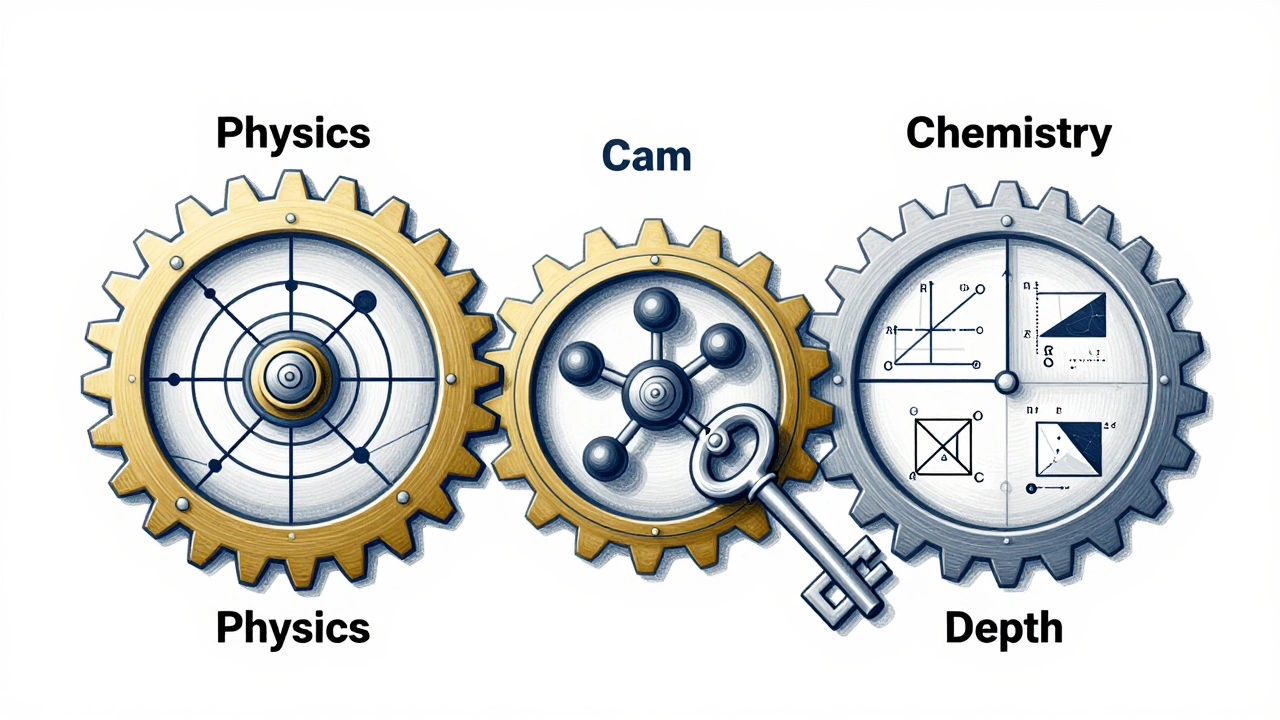
Mathematics Syllabus: The Ultimate Problem-Solving Game
Mathematics is where the top scorers separate themselves. It’s not about how many formulas you know - it’s about how fast you can apply them under pressure.
- Algebra - Quadratic equations, complex numbers, sequences, permutations, probability, and matrices. Probability questions in Advanced often involve conditional probability with real-life contexts - like drawing balls from bags with replacement or without.
- Calculus - Limits, continuity, differentiation, integration, differential equations. This is the heaviest section. Expect 7-8 questions in JEE Main alone. Integration by parts, substitution, and area under curves are must-knows.
- Coordinate Geometry - Straight lines, circles, parabolas, ellipses, hyperbolas. Learn the standard forms cold. A question might give you a tangent to a parabola and ask for the point of intersection with another curve - that’s two concepts in one.
- Trigonometry - Identities, equations, inverse functions. Often combined with calculus or coordinate geometry. Don’t treat it as separate.
- Vectors and 3D Geometry - Direction ratios, planes, lines in space. These are visual. If you can sketch the scenario, you can solve it.
Advanced Math questions are designed to trap you. They look simple, but the trick is in the setup. For example, a question might ask you to find the area bounded by curves - but the curves are defined parametrically. You need to recognize the form before you integrate.
What’s Not in the Syllabus? The Hidden Gaps
Many students waste time on topics outside the syllabus. Here’s what you can safely ignore:
- Advanced quantum mechanics models (like Schrödinger’s equation derivations)
- Organic synthesis beyond Class 12 level (no multi-step synthesis of complex drugs)
- Statistical analysis beyond basic probability
- Calculus of several variables (partial derivatives, multiple integrals)
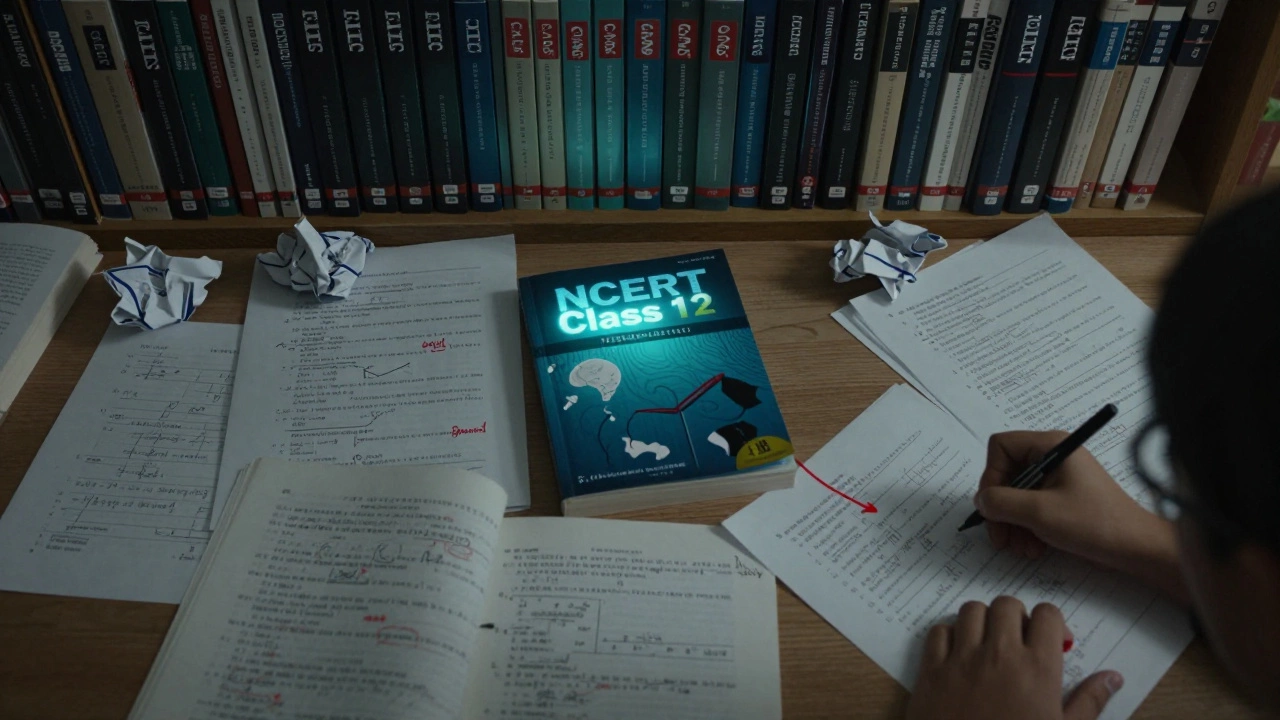
Stick to NCERT for Class 11 and 12. That’s your base. Then move to standard JEE books like H.C. Verma for Physics, O.P. Tandon for Chemistry, and R.D. Sharma for Math. Don’t jump into IIT-level books before mastering the core.
How to Use the Syllabus as a Study Map
Don’t just read the syllabus. Turn it into a tracker.
- Print the official syllabus. Highlight the units you’ve completed.
- Track your weak areas. If you keep missing questions on electrostatics, go back to the basics - Gauss’s law, electric flux, field due to continuous charge distributions.
- Use past papers. JEE Main 2023 had 3 questions on electromagnetic induction from the same sub-topic. If you’ve seen it once, you’ll recognize it again.
- Time your practice. A JEE Main question should take 2-3 minutes. If you’re taking longer, you’re missing a shortcut.
The syllabus is your compass. Without it, you’re running in circles. With it, you know exactly where to focus - and when to move on.
Common Mistakes Students Make
- Skipping Inorganic Chemistry because it’s "memorization-heavy" - but it’s worth 25% of the Chemistry paper.
- Ignoring NCERT - many Advanced questions are directly based on NCERT examples.
- Practicing only easy problems - JEE Advanced doesn’t reward effort, it rewards insight.
- Believing that solving 1000 problems guarantees success - quality beats quantity. One fully understood problem is worth ten half-solved ones.
Final Tip: The Syllabus Changes - But Not Much
Some coaching centers claim the syllabus is changing every year. That’s false. The last major revision was in 2020. Since then, the NTA has kept it stable. You don’t need to chase updates. Focus on mastering what’s already there.
The IIT JEE syllabus isn’t designed to overwhelm. It’s designed to test depth, clarity, and consistency. If you know every topic inside out - not just how to solve, but why it works - you’re not just preparing for an exam. You’re building the mindset of an engineer.
Is the IIT JEE syllabus the same for JEE Main and JEE Advanced?
The syllabus is almost identical, but JEE Advanced goes deeper. JEE Main tests your understanding of core concepts with direct applications. JEE Advanced tests how well you can combine multiple concepts, think critically, and solve complex, multi-step problems. For example, a mechanics problem in JEE Main might ask for the acceleration of a block on an inclined plane. In JEE Advanced, it might ask you to find the acceleration while considering friction, pulley mass, and string elasticity - all at once.
Can I skip any topic in the JEE syllabus?
No. Every topic in the official syllabus has appeared in past papers. Even seemingly minor units like dimensional analysis or communication systems have had direct questions. Skipping any chapter increases your risk. The exam is designed to cover the entire curriculum evenly. Focus on mastering each unit, not skipping it.
Which subject has the highest weightage in JEE Advanced?
Mathematics usually has the highest weightage, followed closely by Physics. In JEE Advanced, Mathematics often contributes 30-35% of the total marks, while Physics and Chemistry each contribute around 30%. But the difficulty varies. Advanced Physics questions are often more conceptual, while Math questions are more calculation-heavy. Don’t assume one subject is easier - your strength should match the exam’s balance.
Are NCERT books enough for JEE syllabus?
NCERT books are the foundation - not the full preparation. They explain concepts clearly and cover 70-80% of JEE Main. But for JEE Advanced, you need deeper practice. Use NCERT to build clarity, then move to advanced books like I.E. Irodov for Physics, Morrison & Boyd for Organic Chemistry, and Cengage for Math. NCERT gives you the language; advanced books give you the tools to win.
How often is the IIT JEE syllabus updated?
The IIT JEE syllabus is reviewed every few years, but changes are rare. The last major update was in 2020. Since then, the NTA and IITs have kept it unchanged. You don’t need to track annual updates. Focus on mastering the current syllabus. Official updates are announced on the JEE Main and JEE Advanced websites - but if you’re following a standard coaching plan, you’re already on track.






0 Comments