
MBA vs Masters Decision Tool
Find Your Best Degree Path
Answer 3 quick questions to determine whether an MBA or Masters degree aligns better with your career goals.
Answer the questions above to see your personalized recommendation.
When you’re thinking about going back to school, two names keep popping up: MBA and Masters. They sound similar, both require a bachelor’s degree, and both can boost your career. But they’re not the same. Confusing them could cost you time, money, and opportunity. So what’s the real difference between an MBA and a Masters? Let’s cut through the noise.
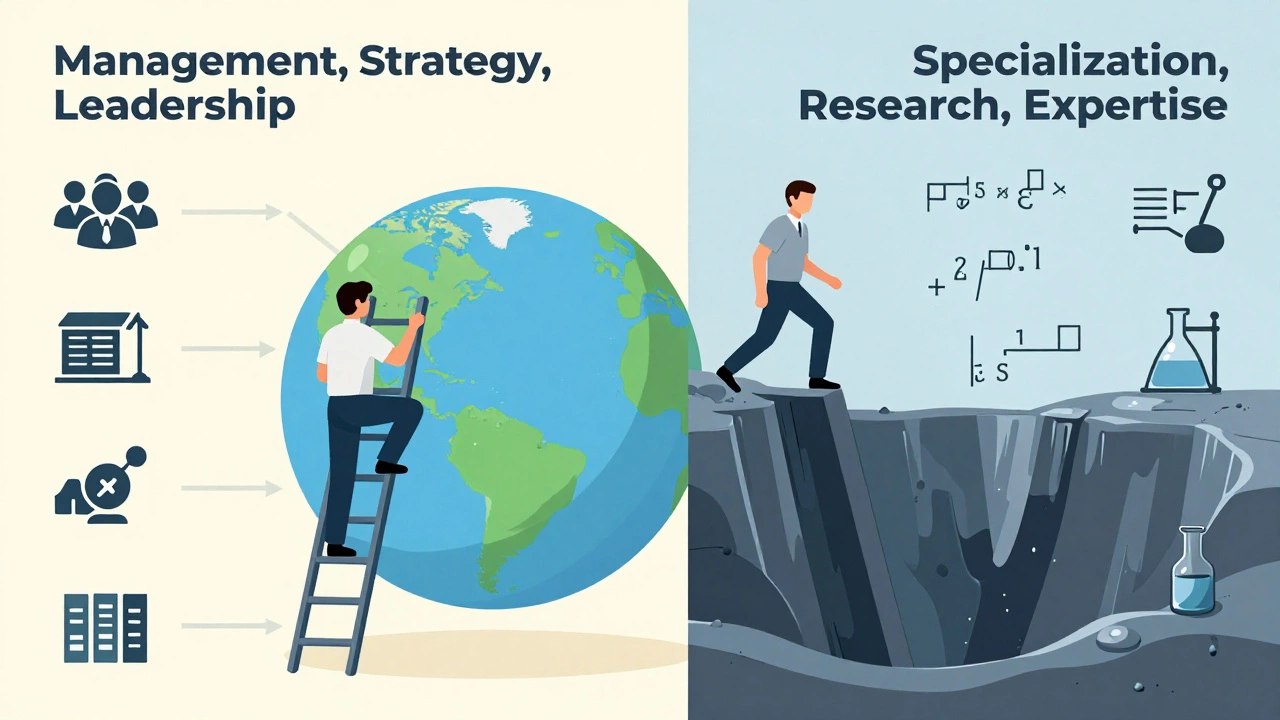
MBA Is Built for Leadership, Not Just Specialization
An MBA is a Master of Business Administration. It’s not just another degree-it’s a management toolkit. Unlike most Masters programs that dive deep into one subject, an MBA gives you a broad view of how businesses work. You’ll study finance, marketing, operations, strategy, leadership, and even ethics-all in one program.
Think of it this way: if you’re a software engineer who wants to lead a team, or a nurse who wants to run a hospital unit, or a sales rep who wants to manage a regional office-an MBA is designed for that leap. It’s not about becoming a better coder or a better doctor. It’s about becoming someone who can manage people, budgets, and projects across departments.
Most full-time MBA programs last two years. But there are also one-year options, part-time formats, and online versions. The curriculum is structured around real-world case studies. You’ll analyze how companies like Apple, Amazon, or Unilever made decisions. You’ll role-play negotiations. You’ll build business plans with classmates who come from totally different industries. That diversity? It’s intentional.
Masters Degrees Are Deep Dives Into a Single Field
A Masters degree (like a Master of Science or Master of Arts) is focused. You pick a subject-data science, public policy, psychology, mechanical engineering-and you go deep. There’s little time for general business topics. The goal is to become an expert in that area, not a generalist.
For example, a Master’s in Finance will teach you advanced valuation models, derivatives, and portfolio theory. A Master’s in Computer Science might focus on machine learning algorithms or distributed systems. A Master’s in Education might explore curriculum design and learning psychology. These programs are research-heavy. Many require a thesis or capstone project.
Most Masters programs take one to two years. They’re common in technical, academic, or creative fields. If you want to become a professor, a data analyst, a policy advisor, or a UX designer with advanced credentials-a Masters is often the right path.
Who Is Each Program For?
Here’s the clearest way to tell which one fits you:
- Choose an MBA if you want to move into management, switch industries, or lead teams. It’s ideal for people with 2-5 years of work experience who are ready to step up.
- Choose a Masters if you want to deepen your expertise in your current field. It’s ideal for recent grads or professionals who need advanced technical skills to stay competitive.
Let’s say you’re a marketing coordinator with three years of experience. You’re good at running social media campaigns, but you want to lead the whole department. An MBA will teach you how to manage budgets, hire staff, and align marketing with company strategy. A Masters in Marketing might teach you how to use AI tools for customer segmentation-but it won’t teach you how to run the team.
On the flip side, if you’re a civil engineer who wants to specialize in sustainable infrastructure design, a Master’s in Civil Engineering makes more sense than an MBA. You don’t need to learn how to manage HR-you need to master new modeling software and environmental regulations.
Cost, Time, and ROI: What You Really Pay
Both degrees are expensive, but the costs differ.
A top-tier MBA can cost $100,000 or more, especially at elite U.S. schools. But many MBA grads land jobs with starting salaries of $120,000-$150,000. Companies like McKinsey, Google, and J.P. Morgan recruit directly from MBA programs. The return on investment (ROI) is often clear: you’ll likely see a 50-100% salary bump within two years.
A Masters program? It’s cheaper. Tuition might range from $20,000 to $60,000 depending on the field and country. Salaries vary more. A Master’s in Data Science might lead to an $85,000 job. A Master’s in Literature? Maybe $45,000. ROI isn’t always guaranteed. Some Masters degrees are stepping stones to PhDs, not direct career accelerators.
Also, consider time off work. MBA programs often expect you to take a break from your job. Many Masters programs let you study part-time while working. That’s a big factor if you can’t afford to stop earning.
Admissions: What Schools Look For
Getting into an MBA program? They want work experience. Most top programs require at least two years. They’ll ask for your resume, essays, recommendations, and often a GMAT or GRE score. Interviews are common. They’re looking for leadership potential, not just grades.
For a Masters? Experience matters less. Recent undergrads get in all the time. You’ll need transcripts, test scores (GRE or subject-specific exams), a statement of purpose, and sometimes a portfolio (for design or writing programs). Research experience can be a big plus.
One key difference: MBA applicants are often evaluated on their career trajectory. Masters applicants are evaluated on their academic fit.
Can You Do Both?
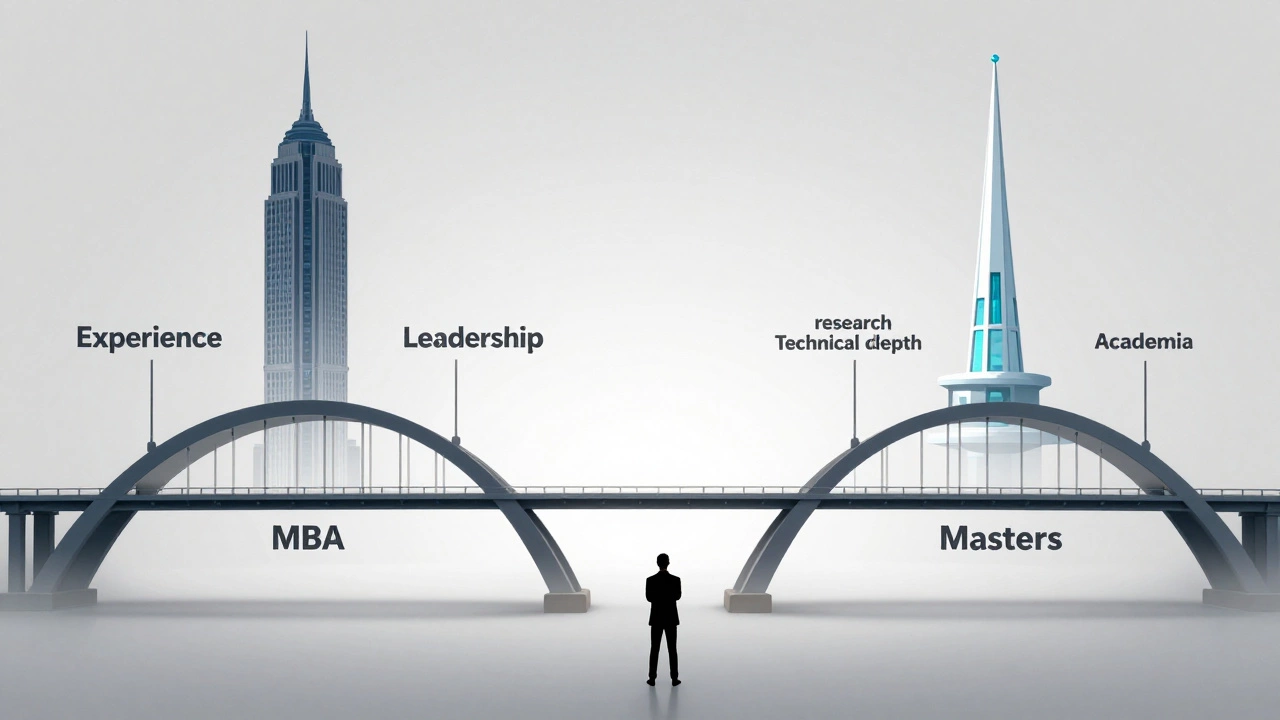
Yes-and some people do. A common path: get a Masters first, then work for a few years, then get an MBA. For example, someone with a Master’s in Engineering might work as a project manager, then get an MBA to move into executive leadership. That combo can be powerful.
But don’t do both just because you think it looks impressive. If you already know you want to lead teams and manage businesses, start with the MBA. If you want to master a technical skill, start with the Masters. Doing both without a clear reason is expensive and unnecessary.
Global Differences Matter
In the U.S., MBA programs are often two years and require work experience. In Europe, many MBA programs are one year and accept students straight out of undergrad. Some European schools even offer “pre-experience” MBAs for recent grads.
Also, in countries like India or the UK, a “Masters” degree is often the default graduate path. An MBA is seen as a professional degree, similar to a law degree. In contrast, in Germany, you might pursue a Master of Science in Business Administration-which is technically a Masters but taught like an MBA.
So don’t assume all MBA programs are the same. Check the curriculum. Look at who teaches it. Ask where graduates end up.
Which One Should You Choose?
Ask yourself three questions:
- Do I want to manage people and projects-or become a deeper expert in my field?
- Do I have work experience, or am I just finishing undergrad?
- Am I looking for a quick salary jump-or long-term expertise?
If you answered “manage people,” “have experience,” and “want a big raise”-go MBA.
If you answered “deepen skills,” “just graduated,” or “need credentials for a technical role”-go Masters.
There’s no right or wrong. Just the right fit.
Is an MBA better than a Masters?
Neither is universally better. An MBA is better if you want leadership roles, career switches, or higher management salaries. A Masters is better if you want to specialize deeply in a technical, academic, or creative field. The best choice depends on your goals, background, and industry.
Can I get an MBA without work experience?
Some programs, especially in Europe and Asia, accept students straight out of undergrad. These are called pre-experience MBAs. But top U.S. programs rarely do. Most expect 2-5 years of work experience. If you’re fresh out of college, a Masters might be a better first step.
Do I need to take the GMAT for an MBA?
Many top MBA programs require the GMAT or GRE, but an increasing number are test-optional. Schools now look more at work experience, essays, and interviews. Still, a strong score can help if your GPA is low or you’re switching industries. Always check the specific school’s requirements.
Is a Masters degree worth it if I already have a job?
It depends. If your job requires advanced technical skills-like becoming a certified data scientist or project manager-then yes. But if you’re stuck in a role because you lack leadership experience, a Masters won’t help much. An MBA might. Ask yourself: am I hitting a technical wall or a promotion wall?
Which degree has better job prospects?
MBA graduates often land roles in consulting, finance, corporate management, and startups-with higher starting salaries. Masters graduates find jobs in specialized fields: engineering, healthcare, IT, public policy, or academia. Both have strong prospects, but the paths are different. An MBA opens doors to leadership; a Masters opens doors to expertise.







0 Comments