MBA Application Strategy Calculator
Your Profile & Constraints
School Category Guide
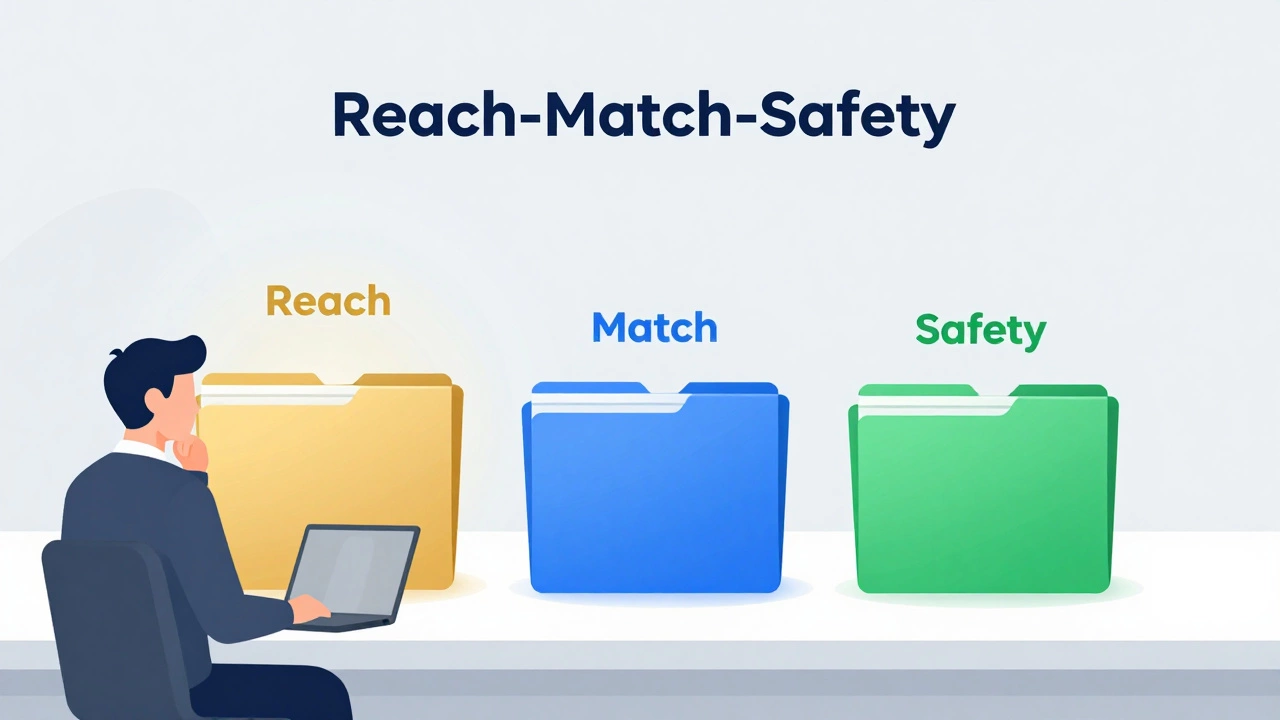
Dream programs where your stats are below median. Acceptance rates typically 15-20%. Examples: Harvard, Stanford, Wharton.
Realistic targets where your profile aligns with average admitted students. Strong regional or national programs ranked 10-30.
Programs where you're likely accepted and may receive scholarships. Essential for risk management and backup options.
Your Personalized Application Strategy
Total Schools Recommended
Estimated Application Fees
Estimated Time Investment
Reach Schools
2
Apply to these dream programs with exceptional essays demonstrating unique fit.
Match Schools
3
Focus heavily here. Your profile aligns well - highlight specific achievements and goals.
Safety Schools
1
Essential backup. Research scholarship opportunities and strong local networks at these programs.
Key Recommendations:
Applying to an MBA is a master's degree in business administration designed for career advancement and leadership skills program is expensive, time-consuming, and emotionally draining. One of the first questions candidates ask is: "How many schools should I apply to?" There is no single magic number that guarantees admission. However, applying to too few schools leaves you with zero options if your dream school rejects you. Applying to too many drains your wallet and dilutes the quality of your applications.
The sweet spot for most applicants in 2026 is between five and eight schools. This range allows you to target a mix of reach, match, and safety schools without burning out or breaking the bank. Your exact number depends on your profile strength, financial constraints, and how specific you are about location or specialization.
Understanding the Reach-Match-Safety Framework
To decide how many schools to apply to, you need to categorize them based on your likelihood of acceptance. This framework prevents the common mistake of applying only to top-tier programs where acceptance rates hover around 15-20%. It also stops you from wasting money on schools you wouldn't actually attend.
| Category | Definition | Recommended Number |
|---|---|---|
| Reach Schools | Schools where your stats (GMAT/GRE, GPA) are below the median and admission is highly competitive. | 2-3 |
| Match Schools | Schools where your profile aligns closely with the average admitted student's profile. | 2-3 |
| Safety Schools | Schools where your stats are above the median, giving you a high probability of acceptance and potential scholarships. | 1-2 |
Reach schools are your dream programs. These might be the top-ranked institutions like Harvard Business School or HBS, Stanford Graduate School of Business, or Wharton School. Even with perfect scores, admission is never guaranteed because these schools look for specific narratives, diversity, and unique experiences. If you apply to three reach schools, statistically, you might get into one, but it could also be zero. That’s why you need backups.
Match schools are realistic targets. Your GMAT score and undergraduate GPA fall within the middle 80% range of their incoming class. These schools value your professional experience and fit. Examples might include strong regional programs or national schools ranked between 10 and 30, such as University of Chicago Booth School of Business or MIT Sloan School of Management, depending on your specific profile strength relative to their medians.
Safety schools are crucial for risk management. These are programs where you are likely to be accepted and may even receive merit-based scholarships. Don’t dismiss them as inferior; many offer excellent ROI and strong local networks. A safety school ensures you have an offer in hand while waiting for decisions from reach schools.
Factors That Influence Your Application Count
While five to eight is a good baseline, several personal factors should adjust this number up or down.
Your Academic Profile: If your undergraduate GPA is low or your GMAT/GRE score is significantly below the median of your target schools, you should lean toward more match and safety schools. In this case, applying to eight or nine schools increases your chances of getting at least one offer. Conversely, if you have a near-perfect profile (e.g., 4.0 GPA and 750+ GMAT), you can afford to be selective and apply to fewer, higher-quality programs, perhaps focusing on four to five reach schools.
Financial Constraints: Application fees are significant. Most top MBA programs charge between $200 and $275 per application. Applying to eight schools can cost over $2,000 just in fees. Additionally, you must consider interview travel costs, test prep expenses, and consultant fees. If budget is tight, prioritize quality over quantity. Focus on two reach, two match, and one safety school. Look for fee waivers, which some schools offer for veterans, underrepresented groups, or alumni children.
Geographic Preferences: Do you want to stay in a specific region? If you are committed to studying in Europe, your pool of schools shrinks dramatically compared to applying globally. In this scenario, applying to six European schools might be the maximum sensible number. If you are open to any location, you can diversify your list across the US, Europe, Asia, and Canada, potentially increasing your application count to eight or ten.
Career Goals: Are you looking to switch industries? If you are moving from engineering to finance, you need schools with strong finance recruiting pipelines. This narrows your list to programs known for that specific outcome. If your goals are broader, you can cast a wider net. Research each school’s career services data to ensure they support your intended path.

The Cost of Quality Dilution
A common pitfall is applying to twelve schools to maximize odds. This often backfires. Writing compelling essays requires deep reflection and customization. Each application asks different questions about your leadership style, failures, and vision. If you spread yourself too thin, your essays become generic and weak. Admissions committees can spot a copy-pasted narrative from a mile away.
It is better to submit five exceptional applications than ten mediocre ones. High-quality applications demonstrate genuine interest and fit. They show you’ve done your homework on the curriculum, clubs, and culture. This effort signals that you will contribute actively to the community, which is what schools want.
Consider the time investment. A thorough application takes 20-30 hours per school, including researching, drafting, revising, and gathering recommendations. For eight schools, that’s 160-240 hours. Ensure you can dedicate this time without compromising your current job performance, as strong letters of recommendation from current managers are vital.

Timing and Rounds Matter
When you apply affects how many schools you should target. Early rounds (Round 1 and Round 2) typically have higher acceptance rates and more scholarship availability. If you plan to apply in early rounds, you can stick to the standard five-to-eight range. If you are applying in Round 3, seats are limited, and competition is fiercer. In this case, broaden your list to include more match and safety schools to hedge against the lower odds.
Also, consider deferring or rolling decisions. Some schools allow you to defer admission by a year. Having a safety school offer gives you leverage and peace of mind. You can wait for reach school decisions knowing you have a backup plan.
Building Your Shortlist Strategically
Start by identifying your non-negotiables. Is it ranking? Location? Specialization (e.g., tech, healthcare, entrepreneurship)? Culture? Create a long list of 15-20 schools that meet these criteria. Then, filter them down using data.
Use tools like Poets&Quants, The Wall Street Journal, and official school websites to compare median GMAT scores, GPAs, and employment outcomes. Calculate your "score gap"-the difference between your stats and the school’s median. A gap of -20 points or more suggests a reach school. A gap of +10 points or more suggests a safety school.
Attend virtual information sessions and webinars. Engage with current students on LinkedIn. Ask about class size, cohort diversity, and career support. This research helps you write authentic essays and confirms whether a school truly fits your needs.
Finally, seek feedback. Share your shortlist with mentors, alumni, or admissions consultants. They can provide perspective on your profile’s competitiveness and suggest adjustments. An outside view can prevent bias and help you balance your list effectively.
Is it better to apply to more schools or fewer?
For most applicants, applying to 5-8 schools is optimal. Fewer than 5 increases the risk of having no offers, especially if you target only competitive programs. More than 8 often leads to diluted essay quality and excessive costs. The goal is to balance probability with resource allocation.
What if I get rejected from all my reach schools?
This is why safety schools are essential. If you have applied to at least 1-2 safety schools, you should still receive an offer. Use this offer to reapply to reach schools the following year with strengthened credentials, or enroll in the safety school if it meets your career goals. Many successful executives attended non-top-tier MBA programs.
Can I apply to international MBA programs to increase my chances?
Yes, diversifying geographically can help. European schools like INSEAD or London Business School have different admission cycles and preferences than US schools. However, ensure you are genuinely interested in relocating and that the program aligns with your post-MBA career plans.
How do application fees impact my decision?
Application fees range from $200 to $275 per school. For 8 schools, this totals $1,600-$2,200. If budget is tight, prioritize fee waivers available through veterans organizations, alumni associations, or diversity initiatives. Never let cost force you to skip a dream school if you can secure a waiver.
Should I use an MBA admissions consultant?
Consultants can help refine your strategy and essays, but they are expensive ($5,000-$15,000). If you hire one, focus your applications on 4-6 schools to maximize their impact. If you go solo, you can handle 6-8 applications by dedicating consistent time each week. The key is maintaining high essay quality regardless of who helps.






0 Comments