
Government Job Eligibility Calculator
Check Your Eligibility
Based on Australian Spent Convictions laws and government hiring policies
Getting out of prison doesn’t mean your future is over. In 2025, more employers across Australia - especially in government sectors - are opening doors to people with criminal records. The key isn’t finding a job that ignores your past. It’s finding one that values your growth, reliability, and willingness to rebuild.
Why government jobs are the top choice
Government agencies have stricter hiring rules, but they also have stronger protections for people with criminal records. Unlike private companies, many public sector roles are governed by the Human Rights Commission and state-based Spent Convictions laws. These laws say that after a certain time - usually 10 years for adults, 5 for juveniles - certain convictions no longer need to be disclosed.
That doesn’t mean you walk in and get hired on the spot. But it does mean you’re not automatically disqualified. In fact, government departments like Transport for NSW, Department of Communities and Justice, and local councils actively run re-entry programs. They partner with NGOs like Redfern Legal Centre and Prisoners Assistance Network to hire people who’ve served their time.
Why? Because government jobs are stable. They offer pensions, health insurance, and career progression. For someone rebuilding their life, that stability isn’t just nice - it’s life-changing.
Top 5 government jobs for ex-offenders in 2025
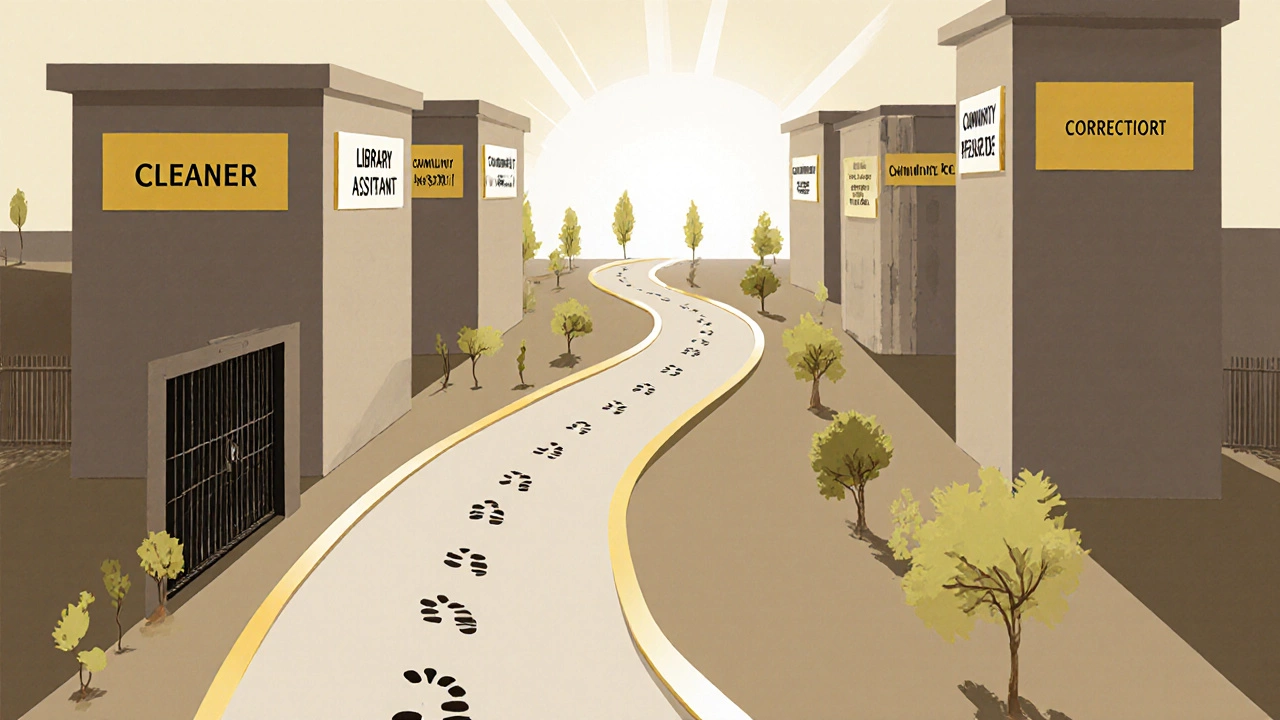
Not all government roles are equal. Some are more accessible, less scrutinized, and better suited to people starting over. Here are the five most realistic and rewarding options right now.
- Cleaner or Maintenance Worker - These roles are in every public building: schools, libraries, hospitals, council offices. Background checks are minimal. You’re hired for reliability, not history. Pay starts at $28-$35/hour with superannuation. Many people start here and move into supervisory roles.
- Community Support Worker - If you’ve been through hardship, you understand it. Government-funded programs for homelessness, addiction recovery, and youth outreach need people who’ve lived it. You’ll need a Certificate III in Community Services, which is often free through JobSeeker or TAFE subsidies. Starting salary: $55,000/year.
- Library Assistant - Libraries are among the most forgiving workplaces. They need people to shelve books, help with computers, run kids’ programs. Most don’t require police checks beyond basic clearance. You get quiet hours, flexible shifts, and a respectful environment. Pay: $27-$32/hour.
- Correctional Officer Trainee - Yes, you read that right. Some states now hire ex-offenders as correctional officers - especially if your offense wasn’t violent or related to abuse. Training is provided. You get to help others avoid the mistakes you made. Salary: $65,000-$75,000/year with overtime.
- Public Transport Operator - Transport for NSW and other state agencies hire bus and train operators with criminal records, as long as it’s not related to violence, fraud, or drug trafficking. You need a driver’s license and a clean driving record for the past 3 years. Training is free. Pay: $30-$38/hour with penalty rates.
What disqualifies you - and what doesn’t
Not every job is open to everyone. But the rules aren’t what most people think.
Here’s what usually blocks you:
- Violent crimes (assault, armed robbery)
- Sexual offenses
- Child abuse or exploitation
- Fraud or embezzlement in government roles
Here’s what usually doesn’t:
- Drug possession (even repeat offenses, if no trafficking)
- Theft or burglary (if over 5 years ago)
- Public order offenses (drunk in public, trespassing)
- Non-violent fraud (if you paid restitution)
Some agencies will still ask about convictions. But they’re required by law to consider your rehabilitation. Did you complete programs? Hold a job? Stay sober? Get a qualification? Those matter more than the offense itself.

How to apply - step by step
Applying for a government job with a record feels scary. Here’s how to do it right.
- Know your record - Get a copy of your criminal history from your state’s police service. In NSW, it’s called a National Police Certificate. You can apply online for $42. Know exactly what’s on it - and what’s spent.
- Use the right job portals - Don’t just search ‘jobs’. Go to Jobs NSW, Victorian Government Jobs, or Queensland Public Service Careers. Filter for ‘Entry Level’ or ‘Trainee’ roles.
- Don’t lie on the form - If asked about convictions, answer honestly. But don’t volunteer extra details. Say: ‘I have a spent conviction under the Spent Convictions Act 1988.’
- Write a simple cover letter - Focus on what you’ve done since. ‘Since my release, I’ve completed a Certificate IV in Community Services, volunteered 200 hours at a youth center, and maintained full-time work for 18 months.’
- Ask for support - Contact your local Reentry Support Centre. They’ll help you polish your resume, practice interviews, and even connect you with employers who hire ex-offenders.
Real success stories
Mark was released in 2020 after serving 6 years for burglary. He started as a cleaner at a public library. Two years later, he completed a TAFE course in library assistance. Today, he manages the children’s section and trains new staff.
Jessica served time for drug possession. She entered a government-funded recovery program and became a peer support worker. Now she helps others navigate the same system she once struggled with.
These aren’t rare cases. In 2024, over 3,200 ex-offenders in NSW alone were hired into public sector roles - up 47% from 2020.
What to avoid
Some jobs sound tempting but aren’t worth it.
- Don’t take cash-only jobs with no paperwork. You won’t build credit, get super, or qualify for future government roles.
- Avoid temp agencies that charge you fees. Legit government support is free.
- Don’t apply for roles requiring a security clearance (like police, defense, or intelligence). Those are nearly impossible unless your record is wiped.
Also, don’t rush. Finding the right job takes time. But the right job doesn’t just pay - it rebuilds your identity.
Where to get free help
You don’t have to do this alone.
- Reentry Australia - Free resume help, interview coaching, job matching. Call 1800 784 228.
- TAFE NSW - Free courses for ex-offenders. No fees, no upfront costs. Courses include Community Services, Warehousing, and IT Basics.
- Jobactive - Your case manager can refer you to employers with open hiring policies.
- Legal Aid - If you’re unsure about your record or rights, they offer free legal advice.
There’s no magic job. But there is a path. And it starts with one application - honest, prepared, and hopeful.
Can I get a government job if I have a criminal record?
Yes, many government jobs are open to people with criminal records - especially if the offense is old, non-violent, and you’ve shown rehabilitation. Most agencies follow Spent Convictions laws, which mean some convictions don’t need to be disclosed after 5-10 years. Roles like cleaner, library assistant, or community support worker are common entry points.
What jobs are off-limits for felons in Australia?
Jobs requiring high-level security clearances - like police, defense, intelligence, or child protection - are typically closed to anyone with a criminal record. Roles involving direct access to vulnerable people (e.g., aged care, childcare) may also be restricted if your offense involved violence, abuse, or fraud. Always check the specific job’s eligibility requirements.
Do I have to disclose my criminal record when applying?
Only if the job application specifically asks. Under Spent Convictions laws, you don’t need to disclose convictions that are legally spent - usually after 5 years for juveniles or 10 for adults, if you haven’t reoffended. If asked, answer honestly but briefly. Focus on what you’ve done since, not the past.
How long does a criminal record last in Australia?
A criminal record never disappears, but under the Spent Convictions Act, many offenses become ‘spent’ after a crime-free period: 5 years for juvenile offenses and 10 years for adult offenses. Once spent, you’re not legally required to mention them in most job applications. Some roles (like working with children) still require full disclosure, regardless of time passed.
Can I get government training or education for free?
Yes. TAFE NSW, Victoria, and Queensland offer free or heavily subsidized courses for ex-offenders through government re-entry programs. Certificates in Community Services, Warehousing, IT, and Hospitality are common. You can also access free resume help, interview coaching, and job placement through Reentry Australia and Jobactive.
Next steps: What to do today
Don’t wait for motivation. Start now.
- Get your National Police Certificate - it costs $42 and takes 3-5 days.
- Visit your local TAFE and ask about free courses for ex-offenders.
- Call Reentry Australia on 1800 784 228 - they’ll send you a list of employers hiring right now.
- Write one cover letter - even if you don’t send it. Just get your story down.
- Apply to one job this week. Doesn’t matter which. Just start.
Your past doesn’t define your future. But your next step does.






0 Comments