
Government Job Security Risk Assessor
Your Current Status
Select any that apply to you right now:
- ⚠️ Convicted of a crime involving moral turpitude (fraud, theft, etc.)
- 📅 Unauthorized absence for >15 days continuously
- 🗣️ Repeated refusal of lawful orders (Insubordination)
- 💸 Gross negligence causing significant financial loss
- 📉 Poor performance / Mediocre work output
- 🏛️ High political entanglement / Partisan behavior
Termination Risk Assessment
You’ve heard the rumors. You’ve seen the memes. The idea that once you pass the exam and get that stamp on your file, you’re set for life is one of the most persistent myths in career planning. But here’s the uncomfortable truth: government job security isn’t absolute immunity. It’s a high-friction shield. Yes, it is significantly harder to lose a government position compared to a private sector role, but "harder" does not mean "impossible." If you think you can sleepwalk through your tenure without consequences, you’re playing a dangerous game.
Let’s break down why this reputation exists, where the cracks are, and what actually triggers a dismissal. Whether you’re preparing for competitive exams or already sitting at your desk, understanding the mechanics of civil service termination is crucial for long-term career survival.
The Tenure Myth: Why It Feels Like Ironclad Security
The perception of invincibility comes from the procedural hurdles built into public administration. In the private sector, if a manager doesn’t like your vibe or the company misses its quarterly targets, you might get an email saying your services are no longer required. Effective immediately. In public sector employment, the process is designed to be slow, deliberate, and heavily documented.
This slowness is often mistaken for safety. Civil servants typically have tenure rights protected by law. These laws exist to prevent political witch hunts. Imagine a scenario where a new minister takes office and wants to purge everyone who worked for the previous administration. Without tenure protections, public administration would become chaotic with every election cycle. So, the system requires evidence, due process, and often, approval from higher authorities before anyone gets shown the door.
But don’t confuse protection with permanence. The barrier to entry is high, and the barrier to exit is also high-but the exit door definitely opens.
What Actually Gets You Fired?
If performance reviews were the primary driver for firings, government offices would look very different. In reality, poor performance alone rarely leads to immediate termination. It usually leads to stagnation-no promotions, bad ratings, and a lot of awkward meetings. However, there are specific categories of misconduct that trigger the firing process quickly.
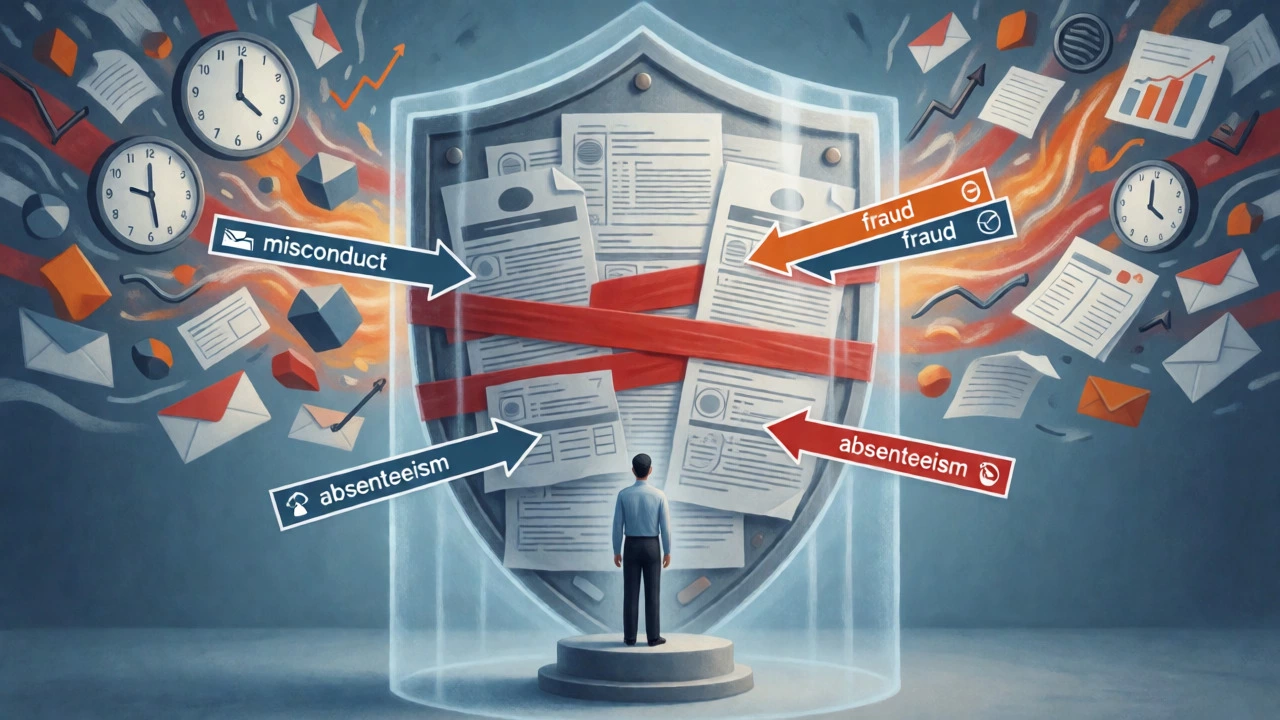
- Moral Turpitude: This is the big one. Crimes involving dishonesty, fraud, or sexual misconduct are non-negotiable. A conviction for theft, embezzlement, or assault usually results in automatic dismissal because it destroys the trust required for public office.
- Absenteeism: While one missed day won’t fire you, unauthorized absence over a sustained period (often defined as continuous absence for 15-30 days depending on jurisdiction) is treated as voluntary resignation or grounds for dismissal.
- Insubordination: Refusing lawful orders from superiors repeatedly can lead to disciplinary action. It’s not just about attitude; it’s about the chain of command.
- Negligence Leading to Loss: If your gross negligence causes significant financial loss to the state or department, you can be held personally liable and dismissed.
Notice what’s missing from that list? "Being average at your job." You can be mediocre for years. You cannot be criminal or insubordinate for long.
The Performance Paradox
Here is where many aspirants get confused. They study hard to get in, assuming they need to keep studying hard to stay in. That’s not how it works. Once you are in, the metric shifts from "how much do I know" to "do I follow procedure."
Poor performance management in government sectors is notoriously weak. Unlike tech companies where low performers are put on Performance Improvement Plans (PIPs) and let go within 90 days, government employees often linger in underperformance for decades. Why? Because proving "incompetence" is subjective and legally risky. Proving "misconduct" is objective and legally defensible.
So, while you might not get fired for being slow, you will likely suffer professionally. You’ll miss out on desirable transfers, promotions, and bonuses. The punishment for mediocrity isn’t always unemployment; sometimes it’s irrelevance.
Comparing Private vs. Public Sector Dismissal
To really grasp the difficulty level, you have to compare the two worlds side-by-side. The friction involved in removing a public servant is exponentially higher than in the corporate world.
| Factor | Private Sector | Government Job |
|---|---|---|
| Speed of Decision | Days to weeks | Months to years |
| Basis for Firing | Performance, culture fit, budget cuts | Misconduct, legal violation, prolonged absenteeism |
| Appeal Rights | Limited (depends on contract) | Extensive (administrative tribunals, courts) |
| Financial Cost | Severance pay, potential lawsuits | Legal defense costs, back pay if reinstated |
| Managerial Risk | Low (HR handles it) | High (manager may face backlash for targeting staff) |
As you can see, the public sector employment model prioritizes stability over efficiency. This means managers often prefer to ignore problems rather than fight them. But when they do fight, they usually win because the evidence bar is so high.
The Probation Trap
Many candidates forget that the first year or two is a probationary period. This is the window where getting fired is actually quite easy. During probation, the government can terminate your services without giving any reason or holding a full inquiry. It’s essentially a trial run.
If you slack off during probation, show up late constantly, or fail basic training assessments, you can be dropped. The moment your confirmation letter arrives, the iron curtain drops. You move from "at-will" style vulnerability to "due process" protection. Don’t treat probation like vacation time. It’s the only time you’re truly vulnerable.
Reforms and Changing Landscapes
Is the landscape changing? Globally, yes. In Australia, where I’m based, there has been a push towards more flexible public service arrangements, though strict tenure still dominates core roles. In other regions, digitalization is making performance metrics more transparent. If you’re lazy now, your digital footprint shows it.
Furthermore, privatization initiatives mean some government departments are being outsourced. When a function moves to a private contractor, the old tenure rules often don’t transfer. Employees might be offered contracts with less security. So, while traditional government jobs remain secure, the definition of "government employee" is evolving.
How to Stay Safe: Practical Advice
If you’re aiming for a government job, don’t worry about being fired for minor mistakes. Worry about major breaches. Here is your survival checklist:
- Document Everything: Keep records of instructions received and tasks completed. If a superior gives a verbal order, send an email summarizing it. "Per our conversation, I will proceed with X." This protects you if things go south.
- Avoid Political Entanglements: Do not become a partisan tool. Serve the institution, not the politician. When administrations change, loyalists of the outgoing regime often face scrutiny.
- Maintain Financial Hygiene: Ensure all your assets are declared correctly. Unexplained wealth is a red flag that triggers audits, which can uncover minor errors that snowball into major issues.
- Respect Hierarchy: Even if you disagree with a decision, execute it professionally. Open rebellion is easier to punish than passive resistance.
Getting fired is rare, but it happens. Usually, it’s not because someone was incompetent, but because they were arrogant, negligent, or corrupt. Stay humble, stay honest, and you’ll likely retire with a pension.
Can a government employee be fired for poor performance?
Yes, but it is difficult. Poor performance must be documented extensively over a long period. Typically, an employee receives warnings and opportunities to improve before termination is considered. Immediate firing for low productivity is rare compared to private sectors.
What is the difference between suspension and dismissal?
Suspension is a temporary removal from duty, often pending an investigation. The employee usually continues to receive a portion of their salary. Dismissal is permanent termination of employment. Suspension is a step in the process; dismissal is the final outcome.
Do government employees have union protection against firing?
In many countries, including Australia and parts of Europe, unions play a significant role. They provide legal representation and advocate for fair procedures. While they cannot prevent dismissal for serious misconduct, they ensure the process is followed correctly, which can delay or overturn unfair terminations.
Is it easier to quit than to be fired?
Yes, resigning is straightforward. You submit a notice, serve the required period, and leave. Being fired involves inquiries, hearings, and potential litigation. Many employees choose to resign quietly when faced with impending disciplinary action to avoid the stigma of dismissal.
Does technology make it easier to track performance?
Increasingly, yes. Digital logging of work hours, project management software, and automated reporting systems create data trails. This makes it harder to hide chronic absenteeism or lack of output, potentially leading to more frequent performance-based actions in the future.







0 Comments