NEET Important Topics: Key Subjects and High-Yield Areas to Master
When you’re preparing for the NEET, National Eligibility cum Entrance Test, the single entrance exam for medical and dental courses in India. It’s not just another test—it’s the gatekeeper to your future as a doctor. The problem isn’t how much you study, but where you focus. Thousands of students grind through entire textbooks, only to miss the core areas that actually show up every year. The truth? NEET doesn’t test everything. It tests the same high-yield topics again and again.
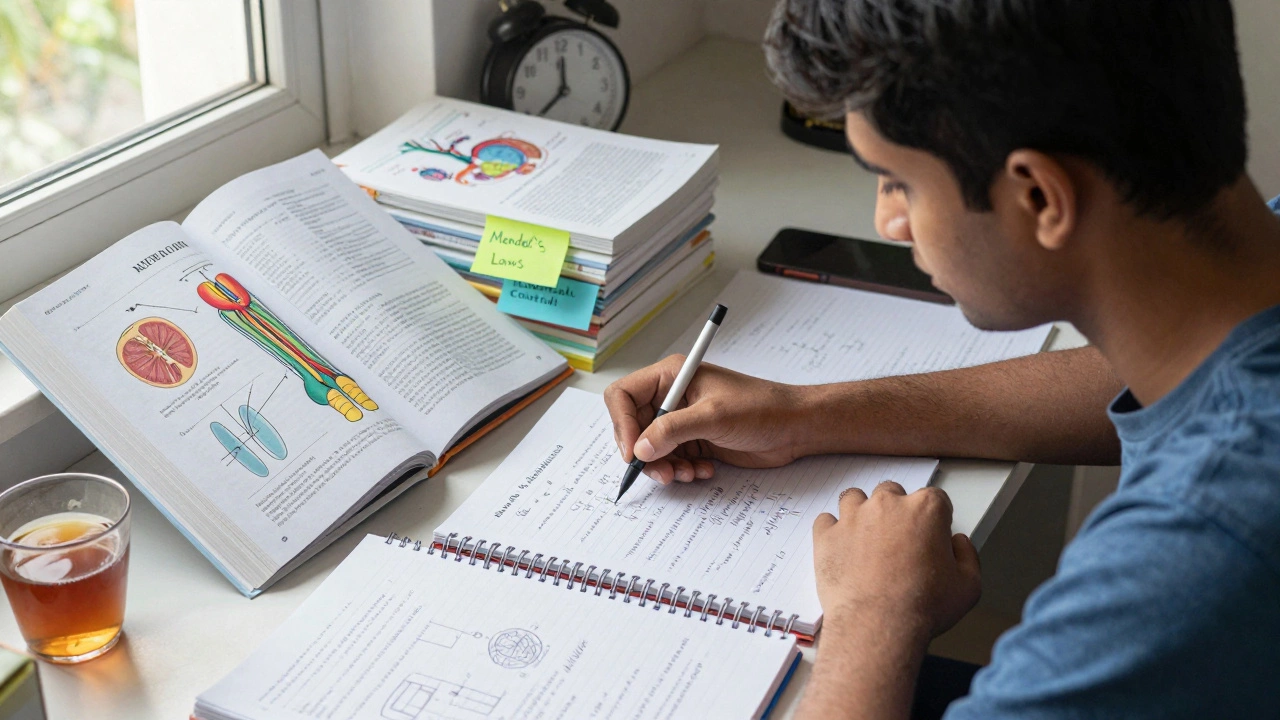
Start with NEET biology, the heaviest section in the exam, making up nearly half the paper and offering the easiest marks if you know where to look. Botany and Zoology are both part of this, but don’t waste time on obscure plant families or rare animal classifications. Focus on Human Physiology—digestion, respiration, circulation, excretion. These are gold. Then there’s Genetics and Evolution: Mendel’s laws, DNA replication, Hardy-Weinberg principle. These show up in every single paper. And don’t ignore Reproduction—male and female reproductive systems, menstrual cycle, embryonic development. These are low-effort, high-reward topics. Master them, and you’ve already cleared 40% of the exam.
Now for NEET chemistry, the subject where precision beats memorization. Organic Chemistry is your best friend if you understand reaction mechanisms. Don’t memorize 50 reactions—learn the patterns: nucleophilic substitution, electrophilic addition, elimination. Know your named reactions: SN1, SN2, Friedel-Crafts, Cannizzaro. Inorganic Chemistry? Stick to the NCERT. Transition elements, coordination compounds, periodic trends—these are tested directly. Physical Chemistry is where most students lose marks. Focus on mole concept, chemical equilibrium, thermodynamics, and electrochemistry. These aren’t hard—they just need practice. Skip the advanced derivations. Stick to what’s in the NCERT and past papers.
Physics is tricky, but even here, the important topics are predictable. Mechanics—laws of motion, work-energy, rotational motion—makes up nearly 30% of the section. Electrodynamics—Coulomb’s law, capacitors, current electricity—is another big chunk. Don’t get lost in optics or modern physics unless you’ve nailed the basics. Prioritize. Solve at least 10 years of past papers. You’ll see the same types of questions repeated with different numbers.
And don’t forget the glue: NCERT textbooks, the official, non-negotiable source for NEET content. CBSE Class 11 and 12 books are all you need for 90% of the exam. Coaching material, YouTube videos, and reference books? They help, but only if you’ve already mastered NCERT. Most toppers say it plainly: NCERT first, everything else second.
You don’t need to know everything. You just need to know what matters. The NEET important topics aren’t secrets—they’re patterns. Once you see them, you stop wasting time and start building confidence. Below, you’ll find real strategies, study plans, and practice tips from students who cracked it. No fluff. No hype. Just what works.
 1 Dec
1 Dec
Which Topic Is Most Important in NEET? Top Priority Subjects and How to Focus Your Prep
Discover the most important topics in NEET to maximize your score. Focus on high-yield biology, chemistry, and physics areas that appear every year and boost your rank with smart prep.